Writers, AI, and Self-Respect
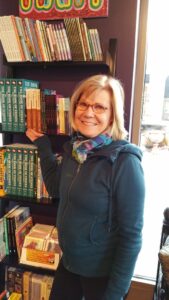
Charlene pictured in a Winter Park, Florid, shop with copies of her memoir, Undertow, on the shelf. 2017
Hello, readers. Today's post is mainly for writers, but
really, like all my posts, it's for all of you.
What about writers and self-respect?
Self-respect is connected to today's topic: writers and AI.
Remember, AI stands for Artificial Intelligence. I know, I know. This
issue of AI is all over the map. Some believe it's helpful in certain fields,
like those pertaining to science and math. But if you ask some of us who care
about literature, you might get a different response. We say something like
this: If you want artificial novels, plays, poems, memoirs and articles spit
out by a machine (in part or in whole), fine. But some of us don't.
We don't want literature like that, and we sure won't write
it like that. We refuse to use AI to create any literary works, i.e. poems,
novels, plays, essays or ANYTHING else, including book reviews. We don't
consider a book, for instance, as a product, although of course it goes into
the marketplace to be sold like one. But some of us believe it shouldn't be
MADE like one. Writing is mysterious. It comes from our hearts, our minds, our
emotions, our imaginations, our intuition, our subconscious that wakes us in
the night serving up the perfect adjective for a character in a story. Of
course, our own life experiences inform our work no matter what we write.
Writing done by a living, breathing human contributes to
understanding the human condition, shared by a human with other humans.
In case you haven't guessed, I do not believe AI is a good
or appropriate tool for writers. Frankly, I think consigning our work to AI
shows a disregard for the creative process that only humans can experience.
There's more on my mind about this, but I'll stop now.
A kindred spirit’s view of AI
A kindred spirit turned up recently: Cal Revely-Calder,
Literary Editor, The Telegraph, who wrote an article titled, In an AI age, writers should have some self-respect.
I read it and said YAY over and over again. Revely-Calder
points out that writers using AI to do their work are actually lacking in
self-respect. He writes, “Writing is thinking. They are inseparable processes.
Circumvent them and you may as well not have bothered.” He argues that if your
confidence in your ability to be a writer is so low that you resort to using a
machine to do it, then stop and do something else. I think that's sound advice.
And on a side note (maybe more of a main note) I'll tell you, this topic
sets off a volcanic eruption in me. Here's why...
What AI did
In case you don't know, AI swept up a whole lot of content
from dedicated writers whose work takes time, reflection, human intelligence,
experience, emotional expression, careful planning, and more. AI has none of
those qualities. It is ARTIFICIAL. It's like a stainless-steel holding tank
with a nozzle that spews out data and information. Where did it get all that?
It stole it from HUMANS. Unlike humans, AI has no ethical or moral aspects to
it.
As far as literature goes, AI has stolen and continues to
steal content from people who worked hard to bring their writing into the
world. In my experience with the field of words, that's called plagiarism. People
who plagiarize (that means steal) lose their jobs, friends, reputations, when
they're caught doing it. In my dreams, they pay fines and go to jail.
Why the AI issue is extra personal to me
This issue is deeply personal, not only because of the
obvious—I am a writer and a writer who wrote a guidebook for the writing life—but also because the cult
leader I followed/adored/obeyed for 17 years, Victor
Paul Wierwille, turned out to be a certain kind of thief: a plagiarist. He
stole content from other people's theological books and Bible classes and
passed it off as his own (see note 1). He did not cite others; he did not
include footnotes acknowledging where he got his information, he certainly
never confessed he'd been a thief. He lamely said he "learned from
others," or that God told him what to write and teach That's it. Back in
1984-1986 when I discovered what Wierwille had done, I quit making excuses for
him and resigned from The Way's biblical research department as fast as I
could. That story is in my memoir, Undertow.
Shamefully, leaders of The Way International™, which is
still in business, have not, and most likely will never, admit Wierwille
plagiarized anything (see note 2), despite evidence given by me and a few
others. To admit he did, might put The Way out of business.
The Authors Guild educates and advocates
I'm a member of The Authors Guild, which offers many
articles about AI and writers. Here's a quote from one, Artificial Intelligence - The Authors Guild.
"Artificial intelligence machines capable of generating text-based works
pose a serious threat to the writing profession and to our
literary culture. Generative technologies built illegally on vast amounts of
copyrighted works without licenses—that is, without giving authors any
compensation or control over the use of their works—are used to cheaply and
easily produce works that compete with and displace human-authored books,
journalism, and other works."
I'll close by again giving you the link to Cal
Revely-Calder's wonderful, articulate, and concise article about AI and
writers. Published on April 7, 2026:
In an AI age, writers should have some self-respect
Notes:
- Wierwille
stole content from E. W. Bullinger's books, such as How to Enjoy the Bible and Bullinger’s The Giver and His Gifts. Stole material for a
Bible class he named, Power for Abundant Living, taken from a class
about gifts of the Holy Spirit by B. J. Leonard; copied a huge amount from Bullinger's The Giver and His Gifts, and a Holy Spirit book by Jack E. Stiles (I have a copy of
Wierwille's book and Stiles's book, and there's no doubt about Wierwille's
theft), and there were more he stole from.
- The
Way's website gives this whitewashed bio of Wierwille: About
the Founder - Dr. Victor Paul Wierwille
Thanks for reading!
Charlene
CHARLENE L. EDGE is the author of the award-winning
memoir, Undertow: My Escape from the Fundamentalism and Cult Control
of The Way International. She spent 17 years (1970-1987) in The Way as
a leader and Biblical researcher.
After escaping the cult, she earned a B.A. in English from
Rollins College in 1994, graduating summa cum laude, and worked for more
than a decade as a writer in the software industry.
A member of the Florida Writers Association, the Authors
Guild, and the International Cultic Studies Association, Edge is also a
prize-winning poet. She lives in Florida with her husband, Hoyt L. Edge,
Professor Emeritus of Philosophy.
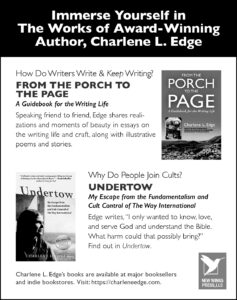
Her latest book is From the Porch to the Page: A Guidebook for the Writing Life (New
Wings Press, LLC. 2022). Both books are sold online in paperback and eBook at
Amazon, Barnes & Noble, and other booksellers.
Read about Charlene and her work: Profile -
Charlene L. Edge - The Authors Guild


Comments